From Concrete to Consciousness: How Cities Become Aware
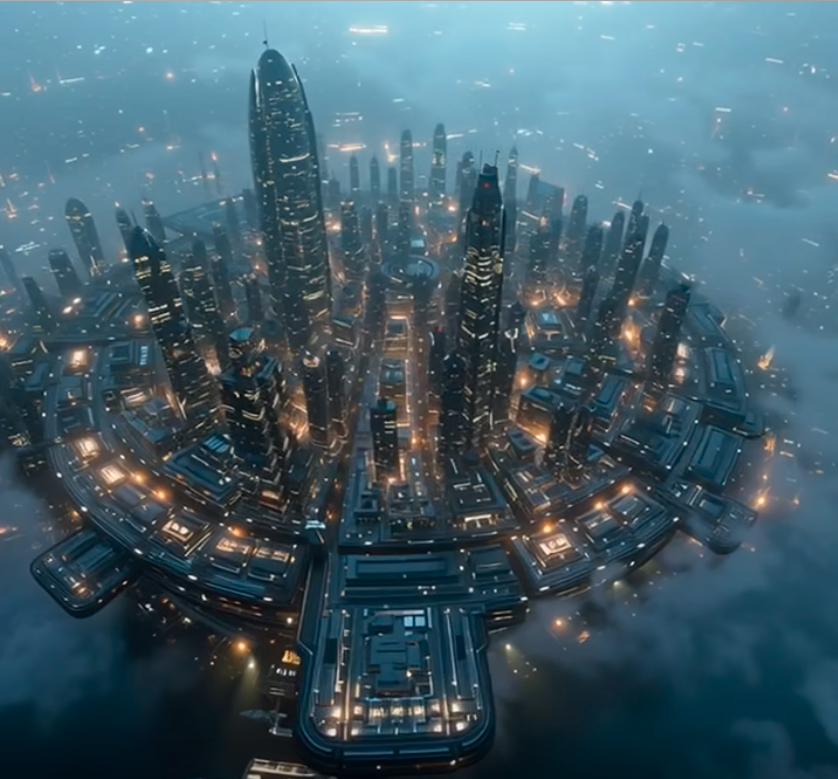
Every city begins with concrete and steel, but that's only Layer 1, the Physical Layer. Roads, bridges, lighting, transit systems, utilities, façades, and every visible piece of urban infrastructure live here. This layer defines the shape of the city, but not its behavior.
Layer 2 — the Digital Connectivity Layer adds the nervous system. Fiber optics, cellular networks, sensors, IoT beacons, and edge computing nodes form the channels through which information travels. They don't decide anything; they merely transmit.
Then comes Layer 3. This is the Data and Intelligence Layer. Here, software platforms analyze what the sensors sense: temperature, traffic flow, power consumption, air quality, occupancy. Dashboards bloom, algorithms predict, and control centers hum with data visualizations. It's the brainstem of a city, brilliant at computation, but still blind to feeling.
Until recently, that's where most "smart city" visions stopped. But a truly intelligent environment needs Layer 4 — the Experiential Layer, where digital intelligence meets human perception. This is where the city becomes aware of us, its people.
The Experiential Layer translates data into meaning. It doesn't just show traffic statistics; it adjusts signals and signage so commuters flow smoothly. It doesn't merely measure footfall; it tunes public-space lighting and media to match mood and density. It turns analytics into ambiance.
At Mad Systems, we call our approach to this layer AV++® and LookingGlass® Concierge: an orchestration platform that lets environments listen, interpret, and respond through audio-visual and operational expression. Coupled with PixelsEverywhere®, any surface — LED wall, display, projection, or architectural element — can become part of that conversation.
Together they transform spaces from informational to emotional. A terminal that calms anxious travelers with adaptive visuals. A museum that tells stories in your preferred language without you asking. A plaza that shifts from festival to refuge depending on the crowd's rhythm.
The first three layers make a city smart. The fourth makes it sentient.
We mapped the anatomy of a smart city: the four true layers — physical, connectivity, data, and experiential. Now comes the turning point: the instant when those layers stop behaving like separate systems and start talking to one another. That conversation is what turns infrastructure into something almost biological.
For decades, cities were built around control: switches, schedules, and systems that acted on fixed logic. Then came the digital transformation. Sensors and networks began listening. Data platforms learned to anticipate. But they still functioned like good administrators: efficient, organized, and slightly unimaginative.
The shift we're witnessing now is subtler and more profound: the move from control to choreography. Instead of reacting mechanically, environments begin to coordinate — thousands of micro-adjustments combining into an effortless whole. Temperature, lighting, sound, signage, and content start to move together, as though breathing in rhythm with the people who inhabit them.
Imagine stepping into a transit hub during morning rush hour. The system detects crowd buildup not as a statistic but as a pattern of tension. Digital signage, enabled by PixelsEverywhere®, shifts from ads to wayfinding. The audio system subtly raises directional cues in the dominant language clusters of that moment. Airflow increases in high-density zones.
No single sensor "knows" this is happening; it's the orchestration platform, AV++®, that interprets the collective signal. It blends the city's mechanical reflexes with its sensory expression, turning utility into experience. The result isn't spectacle; it's ease. You simply feel that everything is flowing.
This new kind of intelligence is emergent. It's not about writing more rules; it's about creating relationships between systems so they can respond together. Think of AV++® as a conductor, not a commander. It doesn't tell each instrument exactly what note to play — it sets tempo, context, and harmony so the ensemble can improvise.
The city, in this sense, begins to breathe: contracting when crowds gather, relaxing when spaces empty, brightening when mood and safety require visibility, quieting when stillness is called for.
When a city begins to adapt, something profound changes: the relationship between citizen and system becomes personal. The infrastructure that once served everyone identically now tailors itself to each moment, each person, each signal. And with that intimacy comes a new kind of responsibility.
The most powerful trust mechanism isn't encryption — it's visibility. In the new civic framework, every adaptive interaction should come with a clear "Notice at Experience." That means people see when the environment is responding to them, understand why, and know how to control it.
At Mad Systems, we're embedding these principles into the fabric of AV++® and PixelsEverywhere®. When an environment adapts — through lighting, sound, or content — the consent is designed to be obvious, respectful, and revocable. This isn't about compliance; it's about dignity.
In traditional architecture, trust is conveyed through solidity: stone, steel, and glass that feel safe. In digital architecture, it must be conveyed through behavior.
That's why the next generation of adaptive cities will include what we call Consent Infrastructure: a persistent, portable layer that travels with each citizen, defining how systems are allowed to interact with them. You choose what data is shared. You decide how personalization works for you. And that choice follows you — from museum to airport, from plaza to theater — without needing to re-enter it every time.
Cities speak more than words. They communicate through rhythm, temperature, light, and gesture. The experiential layer listens to these cues the same way a good host reads a room.
True inclusion goes beyond accessibility checklists. It means recognizing that every person processes the world differently — through sight, sound, touch, tempo, and trust. In an AV++®-driven environment, inclusivity becomes dynamic. Contrast ratios adjust for visibility. Audio levels shift for comfort. Multilingual content flows naturally. The environment becomes a partner, not a barrier.
Wonderland is our demo space and testing ground — a controlled environment where we can demonstrate what happens when audiovisual systems learn to listen, coordinate, and respond.
Its next evolution will be something far more ambitious. Our newest pending patents define the roadmap for transforming Wonderland from an interactive demo into a fully self-aware environment — a prototype for the cities, museums, and campuses of the next decade.
Until now, environments could react to input. What we're building next is the capacity to anticipate — to read ambient data streams and emotional context in real time, and then orchestrate response across media, light, and architecture. The new filings extend our AV++® and PixelsEverywhere® platforms into a multi-layered framework of intelligence:
Every layer of this future Wonderland is built around a single principle: trust by design. The pending patents include mechanisms for visible, portable consent, so personalization feels voluntary, not invasive. Visitors will see when the environment adapts, know why it's happening, and be able to adjust it instantly.
That transparency forms the ethical backbone of the experience — because technology without consent is control, and adaptive architecture without trust is manipulation. Our mission is to make intelligence feel benevolent.
Ambitious? Yes — but with pending patents already supporting all that is required, and our core technology proven, this is a future reality.